

Impoverished Knowing IV
Knowledge that Builds Worlds

Read Part I, Part II, and Part III
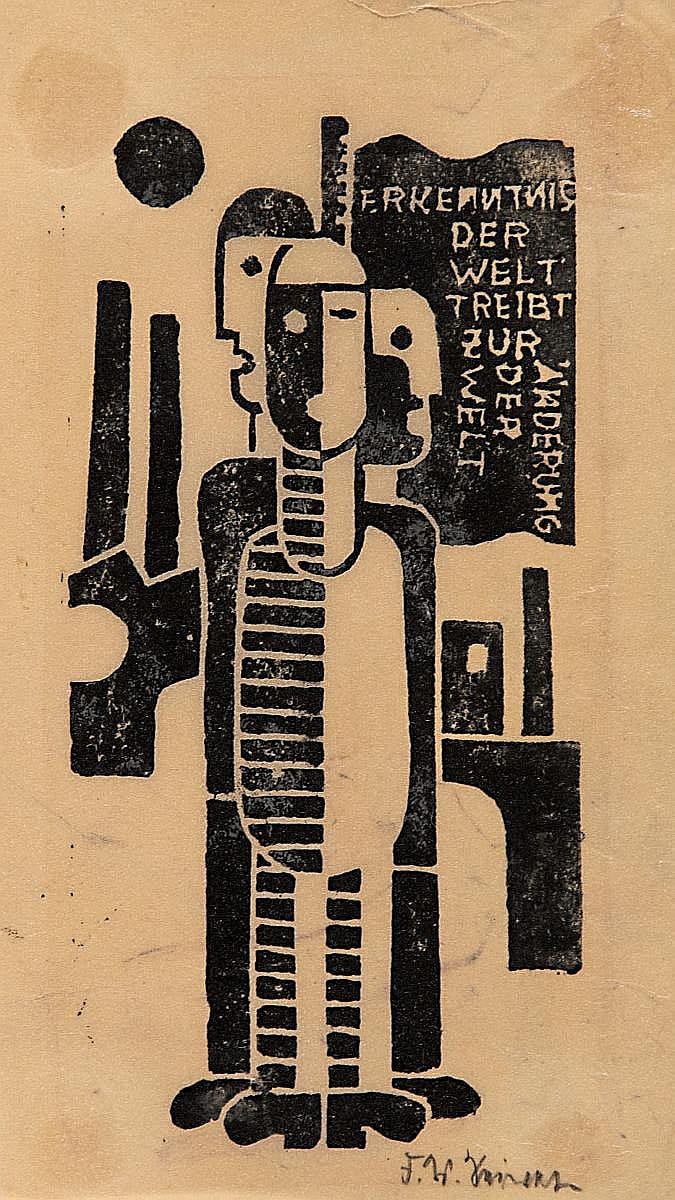
In a print from around 1924, the Weimar artist Franz Seiwert depicts a crowd of three figures, mouths open–perhaps in song, protest chant or lively dialogue–surrounded by abstracted symbols of human world-building and industry. A banner hanging amidst the crowd reads Erkenntnis der Welt treibt zur Änderung der Welt: Knowledge of the World drives the Changing of the World. In the 1920s, this optimism was well-founded. The masses all over the world seemed to be casting off ossified hierarchies. Scientific progress made a post-scarcity world conceivable. Society became legible as an object which could be harnessed towards reciprocal benefit. The traumas of the intervening century have made this sanguinity less and less tenable. If anything, Nietzsche’s foretelling of society becoming paralyzed and sick from an over-saturation of certain forms of knowledge now seems closer to the mark. What would it take to recover the possibility of a purposive knowing? Knowledge that builds worlds?
Thus far, I have sought to offer an account of this disjuncture between our knowledge of the world and the failure of this knowledge to propel us into action. Even though so many of us know, for instance, that the planet is being destroyed by capitalism, few of us have responded with an urgency that this awareness should warrant. Perhaps–I have suggested–our inertia is borne from the deficient forms of knowing that are readily at hand. Clearly, knowing is not merely a matter of having or lacking certain information, but rather it is an embodied practice which brings us into dialogue with other people and our ever-shifting context. The problem for our moment is that the forms of knowing to which we have access cleave us from our historical moment, the material conditions of everyday life, and most consequentially, from each other.
What alternative could there be? How do we get beyond this epistemological impasse? The coordinates for an answer can be derived from the failures of the modes of knowing presented thus far. The reason for their failures gives us a negative outline of what success might entail.

Isolated and yearning for the means to apprehend the world, a prosthesis presents itself that promises communion with the vast reservoir of human knowledge: AI. The impulse to seize it is a correct one insofar as it demonstrates an intuition that rescuing ourselves from nihilistic malaise must entail gaining access to human knowledge in some way. This attempt fails not only because it produces mediocre “answers” which are divorced from living human beings active in the world in the present, but also because it robs us of the deliberative labor that puts us in dialogue with these forces. It prevents, in other words, knowing as a process of becoming with others in the world.
Unsatisfied by the soulless effluvium of antisocial knowledge, which rather than connecting us with the world only drove us further from it, we search in vain for a hearth of human knowers who, like us, seek to be at home, in this world, now. Out in the streets, the scant passersby are all on their way to or from work, or lacking even this anemic purposiveness, have been relegated to a social death, huddled under highway overpasses awaiting another displacement. At the café, everyone, though physically together, is virtually apart: each ensconced in some parochial, self-curated corner of anonymous internet knowing.
In contrast with the streets, social media is abuzz with knowledge production. Whatever our interests, we find a dedicated virtual forum, adorned with its own humor and visual culture. It was the correct impulse to seek out other living humans interpreting the world together in real time, but something is amiss here. The more online we become, the more tenuously connected we are to the lived materiality of the world and the further we are from the scrutiny of people who are different from us. Our thoughts become untethered, stranger. When we try and carry this new knowledge into the real world, we find that it cannot enable us to grasp what we see. Frustrated by this encounter, we might be driven to retreat back into the relative security of our hyper-alienated episteme: our enclosed sphere of knowing that thrives as long as it is untested by the stubborn truths of the world beyond.

Hungry for a real life human community of knowers, a few–perhaps the most fastidious among us–may instead seek a more edified footing from which to apprehend the world. Where else can they turn but to the hallowed gates of academia? Overcoming a thicket of hurdles, they might even acquire the vestments of institutional legitimacy. Though some sparks of genuinely communal ideation might erupt in the cracks of the edifice (and this may be enough to propel the knowledge-seeker through life-denying professionalization), it soon becomes clear that the only knowledge worth having is the kind that valorizes the seigniorial privileges of those pontificating uselessly from academic cathedrae. Worse, the professional knower is dismayed to learn that in cultivating precious access to humanistic knowledge–the very thing that could ignite world-building fervor–they have so thoroughly contorted themselves to the whims of jaded, vengeful and capricious assemblies that they no longer know where their will ends and that of the institution begins. Too late do they feel the force resonating behind the lines:
Freedom do I love, and the air over fresh soil; rather would I sleep on ox-skins than on their honours and dignities.
I am too hot and scorched with mine own thought: often is it ready to take away my breath. Then have I to go into the open air, and away from all dusty rooms.
But they sit cool in the cool shade: they want in everything to be merely spectators, and they avoid sitting where the sun burneth on the steps.
Like those who stand in the street and gape at the passers-by: thus do they also wait, and gape at the thoughts which others have thought.1
Surrounded by the detritus of failed knowing, somnolent unknowing that obscures our authorship of the everyday, a negative image starts taking shape: “The splinter in your eye is the best magnifying-glass.”2 Our misadventures have revealed the spectral possibility of communities of knowers, in and of the world, equipped with the trove of past humanistic knowledge, not as a bad infinity of disconnected particular moments, but as a map pointing towards horizons in which we might thrive. Here are knowers whose thoughts aren’t taxidermied at the moment of their conception, paraded as crude props in a dreary job fair, but instead are planted with others in soil, shaped by and shaping a present and future with which we nurture kinship.

This purposive knowing is coextensive with what Simone de Beauvoir calls freedom. It reveals the frame in which we’ve unknowingly languished and, in this way, makes realizable hitherto foreclosed worlds conducive to collective flourishing. This is not freedom as abstract negation, that is to say, simply a demolition that inevitably confronts others’ pretensions towards the same. As Beauvoir writes in The Ethics of Ambiguity:
…it is not true that the recognition of the freedom of others limits my own freedom: to be free is not to have the power to do anything you like; it is to be able to surpass the given toward an open future; the existence of others as a freedom defines my situation and is even the condition of my own freedom. I am oppressed if I am thrown into prison, but not if I am kept from throwing my neighbor into prison.3
In other words, freedom, or purposive knowing, goes beyond mere revolt towards a reciprocal project of world building that renews itself through constantly opening the space for excluded others:
The prison is repudiated as such when the prisoner escapes. But revolt, insofar as it is pure negative movement, remains abstract. It is fulfilled as freedom only by returning to the positive, that is, by giving itself a content through actions, escape, political struggle, revolution. Human transcendence then seeks, with the destruction of the given situation, the whole future which will flow from its victory.4
The world is only alive with meaning if we project ourselves into it and strive for others to have the conditions to do the same, “disclosing the world for the purpose of further disclosure.”5 Purposive knowing would entail and require building spaces that foster this sort of collaborative labor, maintaining a permeable boundary to the world outside of it through projects: A study group who collaborate on ICE watch. A mutual aid skill share. A democratic union that translates its struggles into a map of the shifting configurations of power and capital. A social club whose programming brings one into contact with social totality of which they are a part. Each of these, unlike the forms of impoverished knowing discussed above, contains the possibility of disclosing something about the world that might not be immediately subsumed. Purposive knowing negates the present, clearing the way towards a future worth fighting for.
It will be stilted. We are out of practice and have been made sick in the miasma of social impossibility. We may even cling fecklessly to old systems of meaning for fear of having none. After all, as Musil writes in The Man Without Qualities, it is our shared fictions, alone, which permit us a fragile, illusory calm. It is only “an extremely artificial state of mind that enables a man to walk upright among the circling constellations and permits him, surrounded as he is by an almost infinite unknown, to slip his hand with aplomb between the second and third buttons of his jacket.” But these fictions can give way: “The final cause of all great revolutions, which lies deeper than their effective cause, is not the accretion of intolerable conditions, but the loss of cohesion that bolstered the society’s artificial peace of mind.”6
Such a revolution may not be a cataclysmic upheaval whose arrival is self-evident, but could be a subterranean process where new modes of knowing burrow unacknowledged until finally tearing asunder older forms:
Spirit in its formation matures slowly and quietly into its new shape, dissolving bit by bit the structure of its previous world whose tottering state is only hinted at by isolated symptoms. The frivolity and boredom which unsettle the established order, the vague foreboding of something unknown, these are the heralds of approaching change. The gradual crumbling that left unaltered the face of the whole is cut short by a sunburst which, in one flash, illuminates the feature of the new world.7
In a moment of weakness, I dissociate and lose myself in my phone: I see an endless stream of frivolity, boredom and vague foreboding. I see impoverished knowing. Disabused finally of all life-denying paths which prevented me from reaching the world, I know what I must do. I cast a red flare into the night sky, I find my friends, and we build.

“The Cause of Labour is the Hope of the World”:

*~*~ If you have been enjoying Red Flare and live in Chicago ~*~*
Join me for ABSOLUTE ETHICAL LIFE - a reading group about how to rebuild society.
We will start with Hegel’s Philosophy of Right, the Preface and Introduction.
Thurs. May 7, 2026, 7-9 pm at Mouse Arts and Letters, 555 E 31st St, Chicago, 60616.
Nietzsche, Thus Spake Zarathustra, https://www.gutenberg.org/files/1998/1998-h/1998-h.htm#link2H_4_0044
Theodor Adorno, Minima Moralia, New York, Verso, 2005, 50.
Simone de Beauvoir, Ethics of Ambiguity, New York, Open Road, 2018, 97.
Ibid. 32.
Ibid. 79.
Robert Musil, The Man Without Qualities, Vol 1, New York, Vintage, 1995, 574-5.
Hegel, Phenomenology of Spirit, New York, Oxford, 1977, 6.